By Sarah Sheikh
The word curriculum is derived from the Latin word curricle, defined as “course, racing chariot,” and currere, “to run,” according to the New Oxford American Dictionary. A curriculum is more than just a set of objectives. It is a set of objectives aligned with assessments, essential questions, content, or knowledge students would acquire through instruction and skills. A clear curriculum map underpins good lesson planning and instruction in the classrooms. It’s a guide or a torch that new and veteran teachers can use before planning a unit of study. A curriculum map is planned with the end in mind, which determines what the students will achieve, know, and be able to do at the end of the unit.
According to Mary Ann Holt (Getting Results with Curriculum Mapping, 2004), use the following criteria to create a curriculum map:
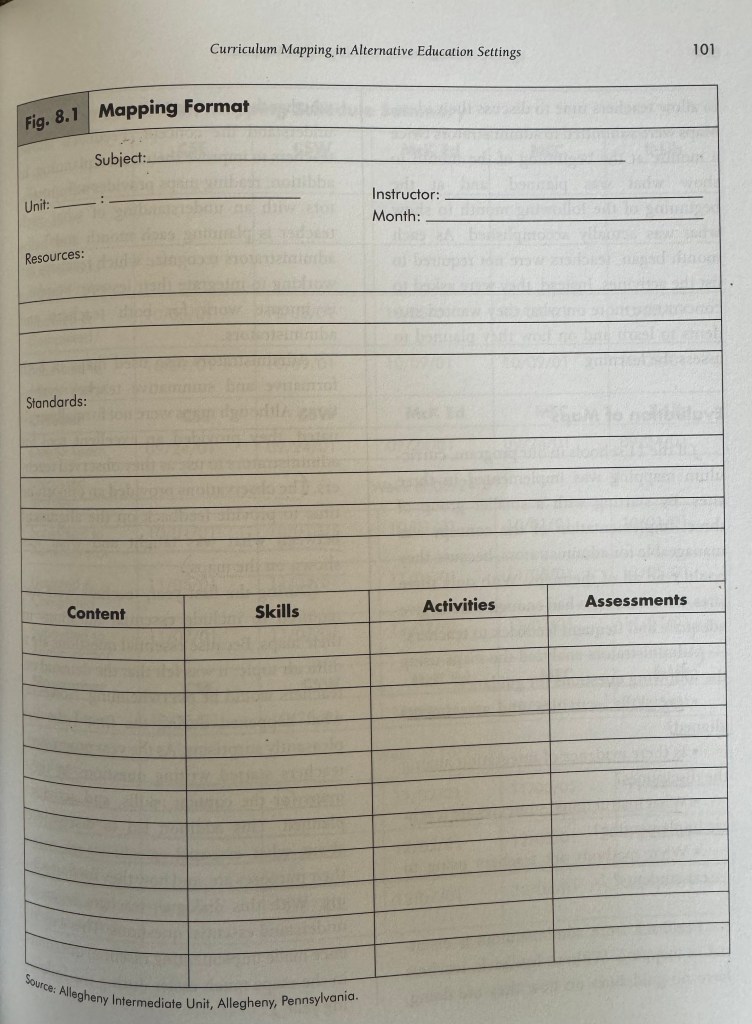
- Content: It encompasses concepts, facts, and events based on a subject matter. Identify the content if you teach geography, which could include concepts or big ideas such as “Human-Environment Interaction.” Big idea concepts can be used to create a more specific and narrow topic, such as deforestation. Identify the topic’s specific knowledge children will acquire within the concepts. Deforestation can be made more specific by identifying events, facts, places where it occurred, and its consequences in the past, present, and future.
- Skills: Skills is a section in the curriculum map that identifies skills that determine what students must do to achieve the learning outcome. Skills can include comparing, modeling, and writing. One crucial aspect of deciding skills for a learning outcome is determining how they are associated with the content being taught.
- Assessments: A curriculum map only requires a list of assessments that will be used to assess the learning outcome through the content and skills. Teachers can choose from various formative assessment strategies such as odd one out, explain to another student, or what went wrong. Summative assessments can include a rubric for a performance task or writing an essay.
Below is an example of a curriculum map template from “Getting Results with Curriculum Mapping,” edited by Heidi Hayes Jacobs.
An excellent curriculum map is the bedrock of outstanding teaching and learning. The absence of a curriculum map that clearly outlines and perfectly aligns the objectives, content, skills, and assessments can lead to an utterly muddled lesson planning, teaching, and learning. According to Lynn Erickson et al., the problem starts with something other than teachers or how they are teaching. Erickson argues, “It is the muddled curriculum design that nurtures muddled thinking.” Larry Ainsworth provides a more detailed curriculum design in his book “Rigorous Curriculum Design.” There are various templates out there for schools to design their curriculum map. However, whichever map the school adopts, the factors underpinning an excellent curriculum map remain the same: to identify the objectives, content, skills, and assessment (formative and summative) in collaborative teams before you start planning lessons and teaching. Teachers starting to plan lessons and teaching without a solid curriculum map can be analogous to a superstructure standing on unstable grounds.
References:
Ainsworth, L. (2010). Rigorous Curriculum Design. Lead+Learn Press
Jacobs, H, J. (2004). Getting Results with Curriculum Mapping. Association of Supervision and Curriculum Development
Erickson, H, L; Landing, A, Lois; French, R. (2017). Concept Based Curriculum and Instruction for the Thinking Classroom. Corwin, A Sage Publishing Company
 The Power of Formative Assessment